
Agenta vs Fallom
Side-by-side comparison to help you choose the right AI tool.

Agenta centralizes LLM development, empowering teams to build reliable AI apps with seamless collaboration and insights.
Last updated: March 1, 2026

See every LLM call in real time for effortless AI agent tracking, analysis, and compliance.
Last updated: February 28, 2026
Visual Comparison
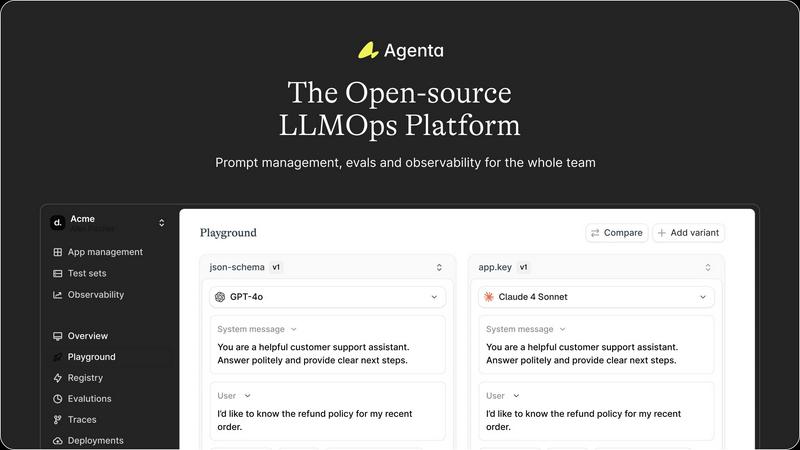
Agenta
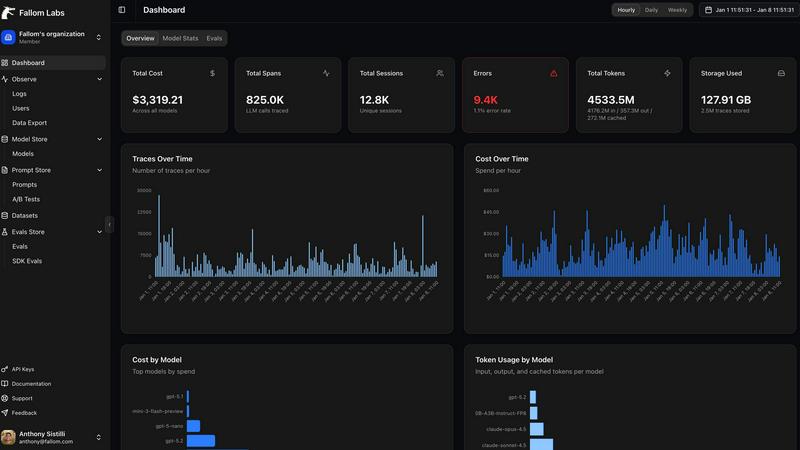
Fallom
Feature Comparison
Agenta
Centralized Prompt Management
Agenta offers a centralized platform where teams can store and manage their prompts, evaluations, and traces. This eliminates the chaos of scattered files across various tools like Slack, Google Sheets, and emails, enabling seamless collaboration.
Automated Evaluation Processes
With Agenta, teams can create systematic evaluation processes that replace guesswork with evidence-driven results. Automated evaluations allow teams to run experiments, track outcomes, and validate changes efficiently, ensuring that every tweak is backed by data.
Unified Playground for Experimentation
The unified playground feature enables teams to experiment with prompts and models side-by-side. This allows for easy comparisons and full version history tracking, ensuring teams can see the evolution of their prompts and revert to previous versions if necessary.
Real-Time Observability
Agenta provides real-time monitoring capabilities that allow teams to trace every request and pinpoint failure points in their AI systems. This level of observability not only aids in debugging but also helps gather user feedback to continuously improve performance.
Fallom
Real-Time LLM Call Tracing
See every interaction as it happens with a live, queryable trace table. Drill down into individual calls to inspect the exact prompt, model response, tool calls with arguments, token usage, latency, and per-call cost. This granular visibility is the foundation for debugging complex agent failures and understanding exactly what your AI is doing in production, turning opaque processes into transparent, actionable data.
Granular Cost Attribution & Analytics
Move beyond vague cloud bills. Fallom automatically breaks down your AI spend by model, user, team, session, or even specific customer. Visual dashboards show you exactly where every dollar is going—whether it's GPT-4o, Claude, or Gemini—enabling precise budgeting, showback/chargeback, and data-driven decisions to optimize for cost-performance without sacrificing quality.
Enterprise Compliance & Audit Trails
Built for regulated industries, Fallom provides immutable, complete audit trails of all AI activity. It logs inputs, outputs, model versions, and user consent, directly supporting requirements for GDPR, the EU AI Act, and SOC 2. Features like configurable privacy mode allow you to redact sensitive data while maintaining full telemetry, ensuring you can deploy AI with confidence.
Advanced Workflow Debugging Tools
Debug complex, multi-step agentic workflows with ease. The timing waterfall visualization breaks down latency across LLM calls and tool executions to pinpoint bottlenecks. Simultaneously, full tool call visibility lets you inspect every function call, its arguments, and returned results, making it simple to identify logic errors or external API failures in intricate chains.
Use Cases
Agenta
Collaborative Development
Agenta is ideal for teams looking to enhance collaboration between product managers, developers, and domain experts. By centralizing workflows, all stakeholders can easily contribute to the LLM development process, ensuring that every perspective is considered.
Rapid Prototyping
For teams that need to iterate quickly on their LLM applications, Agenta provides a structured environment to test and compare different prompts. This facilitates rapid prototyping, allowing teams to refine their models and deploy new features faster.
Performance Monitoring
Agenta’s observability features allow teams to monitor the performance of their LLM applications in real-time. This is crucial for identifying regressions and ensuring that the models continue to meet expected performance levels after updates.
Evidence-Based Decision Making
With automated evaluation processes, teams using Agenta can make data-informed decisions regarding prompt adjustments and model selections. This leads to more reliable outcomes and optimized LLM applications that better serve user needs.
Fallom
Optimizing AI Agent Performance & Reliability
Engineering teams use Fallom to monitor live AI agents handling customer support, data analysis, or booking tasks. By analyzing latency waterfalls and tool call success rates, they can quickly identify and fix performance bottlenecks, reduce error rates, and ensure a reliable user experience, leading to higher customer satisfaction and trust in their AI products.
Controlling and Forecasting AI Operational Costs
Finance and engineering leaders leverage Fallom's cost attribution dashboards to gain full transparency into unpredictable AI spending. They track costs per project, team, or feature, forecast budgets accurately, implement chargebacks, and identify opportunities to switch models for less expensive calls without impacting output quality, directly improving unit economics.
Ensuring Regulatory Compliance for AI Deployments
Legal and compliance teams in healthcare, finance, and enterprise software rely on Fallom to generate the necessary audit trails for AI governance. The platform logs all required data—prompts, responses, model versions, and user consent—providing a verifiable record to demonstrate adherence to GDPR, AI Act, and internal policy requirements during audits.
Improving AI Products with Data-Driven Insights
Product managers and developers use Fallom's session tracking and customer analytics to understand how users interact with AI features. They identify power users, analyze common query patterns, and A/B test different prompts or models using the integrated prompt store and traffic splitting, using real data to iterate and improve product offerings.
Overview
About Agenta
Agenta is a cutting-edge open-source LLMOps platform that is revolutionizing the way AI teams develop and deploy large language model (LLM) applications. Designed to foster collaboration between developers and subject matter experts, Agenta serves as a centralized hub that streamlines the experimentation process and enhances productivity. By addressing the common challenges of unpredictability in LLMs, which often lead to fragmented workflows and ineffective debugging, Agenta empowers teams to work more cohesively. With features like comprehensive prompt management, automated evaluation, and detailed observability, Agenta allows teams to track version histories, test and compare prompts, and monitor production systems in real-time. This structured approach ensures that AI applications are built with confidence, facilitating faster deployment and more robust performance in a competitive landscape. Whether you are a developer, a product manager, or a domain expert, Agenta equips you with the tools needed to build reliable LLM applications efficiently and effectively.
About Fallom
Fallom is the AI-native observability platform that's taking the industry by storm, built from the ground up for the era of Large Language Models (LLMs) and autonomous agents. It solves the critical "black box" problem for engineering and product teams deploying AI in production. While traditional monitoring tools fall short, Fallom provides granular, end-to-end visibility into every single LLM call, tool invocation, and multi-step workflow. Imagine seeing a real-time dashboard of every AI interaction—prompts, outputs, tokens, latency, and exact costs—allowing you to instantly debug a failing agent, optimize a slow chain, or explain a cost spike. Trusted by fast-moving startups and global enterprises alike, Fallom is essential for anyone serious about building reliable, cost-effective, and compliant AI applications. Its unique value lies in unifying cost attribution, performance debugging, and compliance auditing into a single, OpenTelemetry-native platform that you can integrate in under five minutes, finally giving teams the control they need over their AI operations.
Frequently Asked Questions
Agenta FAQ
What makes Agenta different from other LLMOps platforms?
Agenta stands out due to its open-source nature, which encourages community collaboration and contributions. It also provides a centralized workspace for prompt management, evaluation, and observability, simplifying the LLM development process.
Can Agenta integrate with existing tools?
Yes, Agenta is designed to integrate seamlessly with popular frameworks and models, such as LangChain, LlamaIndex, and OpenAI. This integration allows teams to leverage their existing tools while benefiting from Agenta’s robust features.
Is Agenta suitable for non-technical users?
Absolutely! Agenta features a user-friendly interface that enables domain experts and product managers to edit prompts and run evaluations without needing to write code, making it accessible for all team members.
How does Agenta ensure data security?
As an open-source platform, Agenta allows teams to maintain control over their data. Teams can implement their own security measures and configurations to protect sensitive information, ensuring compliance with organizational policies.
Fallom FAQ
How quickly can I integrate Fallom into my existing application?
Integration is famously quick. With the single, OpenTelemetry-native SDK, most teams are sending their first traces and seeing data in the Fallom dashboard in under 5 minutes. There's no need to rip and replace your existing infrastructure; it layers seamlessly on top of your current LLM calls and agent frameworks.
Does Fallom support all major LLM providers and frameworks?
Absolutely. Fallom is provider-agnostic and works with every major provider, including OpenAI (GPT), Anthropic (Claude), Google (Gemini), Cohere, and open-source models. It also integrates with popular agent frameworks like LangChain and LlamaIndex. The OpenTelemetry foundation ensures zero vendor lock-in.
How does Fallom handle sensitive or private user data?
Fallom is built with enterprise-grade privacy controls. You can enable "Privacy Mode" to disable full content capture, logging only metadata like token counts and latency. For more granular control, configurable redaction rules allow you to strip specific PII or sensitive keywords, ensuring compliance with strict data handling policies.
Can I use Fallom to A/B test different models or prompts?
Yes, Fallom includes first-class support for experimentation. You can split traffic between different models (like GPT-4o and Claude 3.5) or different versions of prompts stored in the Prompt Store. The dashboard then lets you compare their performance, cost, and quality metrics side-by-side to make informed, data-driven deployment decisions.
Alternatives
Agenta Alternatives
Agenta is a cutting-edge open-source LLMOps platform designed to facilitate the development and deployment of reliable large language model applications. It serves as a vital tool for AI teams, promoting collaboration between developers and subject matter experts while streamlining the experimentation process. Users often seek alternatives to Agenta due to various factors such as pricing, specific feature requirements, or the need for compatibility with different platforms and workflows. When searching for an alternative to Agenta, it's crucial to consider several key aspects. Look for platforms that offer centralized workflow management and robust collaboration features, as these can significantly enhance productivity. Additionally, evaluating the automation capabilities for prompt evaluations, observability, and debugging tools will help ensure that your team can effectively manage and optimize AI applications without compromising on performance or reliability.
Fallom Alternatives
Fallom is a leading AI-native observability platform in the development category, built specifically for monitoring and managing LLM and AI agent workloads in production. It gives teams deep visibility into every prompt, response, and tool call, which is crucial for debugging and cost control. Users often explore alternatives for various reasons, such as budget constraints, the need for different feature sets, or integration with an existing tech stack. Some teams might prioritize simpler dashboards, while larger enterprises may require more extensive compliance frameworks or specific deployment options. When evaluating other solutions, focus on core capabilities: real-time tracing of LLM calls, detailed cost breakdowns, and robust compliance tools like audit trails. The ideal platform should integrate smoothly with your workflow, scale with your AI usage, and provide clear insights to optimize both performance and spending.