
Blueberry vs OpenMark AI
Side-by-side comparison to help you choose the right AI tool.

Blueberry
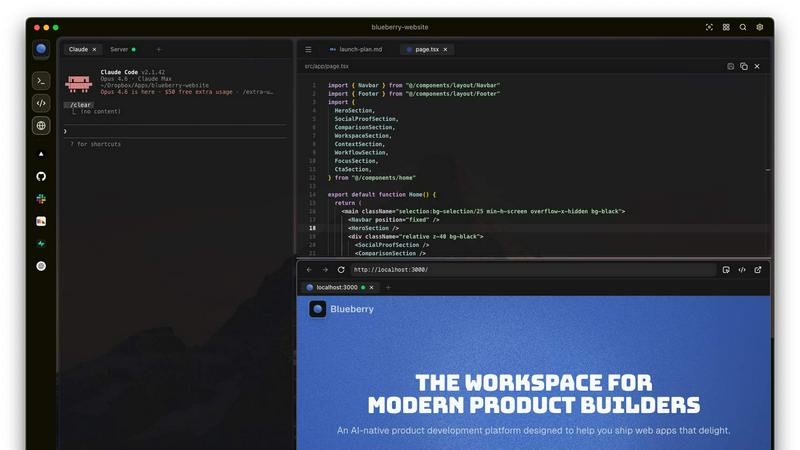
Blueberry is the all-in-one Mac app that unifies your editor, terminal, and browser for seamless web app development.
Last updated: February 28, 2026

Stop guessing which AI model to use; benchmark 100+ models on your actual task for cost, speed, and quality in minutes, no API keys needed.
Last updated: March 26, 2026
Visual Comparison
Blueberry
OpenMark AI
Feature Comparison
Blueberry
Integrated Workspace
Blueberry combines a terminal, code editor, and preview browser into one cohesive environment. This integration eliminates the need for constant app-switching, allowing developers to focus on building and shipping their applications without distractions.
Live Context for AI Models
With Blueberry's MCP server, developers can run AI models directly in the terminal. These models have access to the entire workspace, including open files and terminal output, providing them with the context needed to understand and assist in code development effectively.
Advanced Code Editor
The built-in code editor offers full syntax highlighting, multi-cursor support, find and replace functionality, and Git integration. This robust feature set ensures that users can edit code efficiently while also providing AI models with real-time context for better assistance.
Flexible Preview Options
Blueberry allows developers to preview their applications on desktop, tablet, and mobile views. This feature ensures that developers can see how their users will experience the application, helping to catch any visual discrepancies before deployment.
OpenMark AI
Plain Language Task Benchmarking
Ditch complex configurations and scripting. Simply describe the task you want to test in natural language. OpenMark AI intelligently configures the benchmark, allowing you to run identical prompts across dozens of models instantly. This human-centric approach means you can validate real-world use cases—from email classification to code generation—without writing a single line of code, making advanced testing accessible to entire product teams.
Real API Cost & Performance Comparison
Go beyond theoretical token prices. OpenMark AI makes real, live API calls to each model provider and presents you with a detailed breakdown of the actual cost per request, latency, and scored output quality for every single test. This side-by-side comparison reveals the true trade-offs, helping you find the optimal balance between performance and budget, ensuring you never overpay for capability you don't need.
Stability & Variance Analysis
A single test run is just luck. OpenMark AI runs your prompts multiple times to measure consistency and output stability. See which models deliver reliable, high-quality results every time and which ones produce erratic, unpredictable outputs. This critical feature exposes variance, giving you the confidence that the model you choose will perform consistently in production, not just in a one-off demo.
Hosted Catalog with No API Key Hassle
Access a massive, constantly updated catalog of 100+ leading models without the headache of signing up for and configuring individual API keys from OpenAI, Anthropic, Google, and others. Simply use OpenMark's credit system to run benchmarks. This centralized access dramatically speeds up the evaluation process, letting you focus on analysis and decision-making instead of administrative setup.
Use Cases
Blueberry
Seamless Development
Developers can utilize Blueberry to create web applications without the hassle of managing multiple tools. With everything in one place, teams can collaborate more effectively, ensuring that everyone is on the same page throughout the development process.
Enhanced AI Collaboration
Product teams can leverage AI capabilities by running models like Codex or Claude directly in their workspace. This allows for instant feedback on coding queries or troubleshooting, improving efficiency and reducing the time spent on problem-solving.
Rapid Prototyping
With integrated preview options, designers and developers can quickly prototype and iterate on their web applications. This capability allows teams to gather user feedback faster, leading to better product outcomes.
Contextual Assistance
Blueberry's ability to provide AI models with full context means that developers can receive tailored assistance based on their specific project requirements. This feature reduces the need for manual context switching, allowing for a smoother workflow and better productivity.
OpenMark AI
Pre-Deployment Model Selection
You're about to ship a new AI-powered feature. Instead of guessing between GPT-4, Claude 3, or Gemini, use OpenMark AI to test all contenders on your exact task. Compare real costs, accuracy, and speed in one dashboard to make a data-driven decision that aligns with your technical requirements and budget, ensuring you launch with the best-fit model from day one.
Cost Optimization for Scaling Applications
Your application is live, but API costs are creeping up. Use OpenMark AI to benchmark newer, more cost-efficient models against your current provider. Discover if a smaller, faster model can deliver comparable quality for a fraction of the price, or identify where you can downgrade model tiers without sacrificing user experience, directly boosting your margins.
Validating Model Consistency for Critical Tasks
For tasks where reliability is non-negotiable—like legal document analysis, medical data extraction, or financial summarization—you need consistent outputs. OpenMark AI's repeat-run analysis shows you the variance. Identify which models are stable workhorses and which are unpredictable, preventing costly errors and ensuring trust in your automated workflows.
Prototyping & Research for AI Products
Exploring a new AI concept? Rapidly prototype by testing a wide range of models on your novel task or prompt chain. OpenMark AI lets you quickly see which model families excel at specific capabilities like reasoning, creativity, or instruction-following, accelerating your R&D phase and providing concrete data to guide your development roadmap.
Overview
About Blueberry
Blueberry is an innovative macOS application designed for modern product builders who want to streamline their workflow by consolidating their editing, terminal, and browsing environments into a single focused workspace. Gone are the days of switching between numerous applications, losing valuable context and productivity. With Blueberry, developers can connect with AI models like Claude, Gemini, and Codex through its built-in MCP (Multi-Context Protocol) server, allowing for real-time interaction with code, terminal outputs, and live previews—all in one place. This integration significantly enhances the development process, enabling users to access and manipulate their files seamlessly. Ideal for software engineers, web developers, and product managers, Blueberry empowers teams to build and ship web applications efficiently, transforming how products are developed and launched. Join the community of pioneers who are already experiencing the benefits of this AI-native platform during its free beta phase.
About OpenMark AI
Stop playing roulette with your AI model choices. OpenMark AI is the definitive, no-code platform that lets you benchmark 100+ large language models (LLMs) on your actual tasks before you commit to a single API. Forget datasheet promises and marketing hype. Describe what you need in plain English—whether it's complex data extraction, creative writing, or agentic reasoning—and run the same prompt against a massive catalog of models from OpenAI, Anthropic, Google, and more in one seamless session. You get side-by-side results comparing real API costs, latency, scored output quality, and critical stability metrics across repeat runs. This means you see the variance and consistency, not just a single lucky output. Built for pragmatic developers and product teams, OpenMark AI cuts through the noise with hosted benchmarking credits, eliminating the nightmare of managing a dozen separate API keys. It’s the essential pre-deployment tool for anyone who cares about cost efficiency (quality you get for the price you pay) and shipping reliable AI features with confidence. Join thousands of developers worldwide who have moved from guessing to knowing.
Frequently Asked Questions
Blueberry FAQ
What platforms does Blueberry support?
Blueberry is currently available exclusively for macOS users, providing a focused and optimized experience for Mac developers.
How does Blueberry's MCP feature work?
The Multi-Context Protocol (MCP) allows AI models to access and interact with your entire workspace, including files, terminal output, and browser previews. This ensures that the AI has the context needed to assist effectively.
Is Blueberry really free during its beta phase?
Yes, Blueberry is completely free to use during its beta phase, allowing users to explore all features without any financial commitment.
Can I integrate other tools with Blueberry?
Yes, Blueberry allows you to pin tools like GitHub, Linear, and Figma within the workspace. These integrations help maintain context and streamline your workflow even further.
OpenMark AI FAQ
How is OpenMark AI different from other LLM benchmarks?
Most benchmarks test models on generic, academic datasets. OpenMark AI is built for your specific, real-world tasks. We run live API calls, giving you actual cost and latency data alongside quality scores for your exact use case. We also test stability across multiple runs, showing variance—something static leaderboards completely miss.
Do I need my own API keys to use OpenMark AI?
No! That's a key benefit. OpenMark AI operates on a credit system. You purchase credits and can run benchmarks against our entire hosted catalog of models without ever needing to supply or manage separate API keys from OpenAI, Anthropic, or Google. It's a unified, hassle-free testing platform.
What kind of tasks can I benchmark?
Virtually anything! Developers use it for classification, translation, data extraction, RAG system evaluation, agent routing logic, research assistance, Q&A, image analysis prompts, and creative writing. If you can describe it in plain language, you can benchmark it. The platform is designed for flexible, real-world application testing.
How does the scoring and quality assessment work?
OpenMark AI uses a combination of automated evaluation metrics tailored to your task type (like accuracy, relevance, or faithfulness) and, where configured, can incorporate human-like judgment criteria. The system scores each model's output consistently across all runs, providing a clear, comparable quality metric alongside the hard cost and speed data.
Alternatives
Blueberry Alternatives
Blueberry is an innovative Mac app designed for developers, seamlessly integrating an editor, terminal, and browser into one focused workspace. This powerful tool allows users to connect various AI models, such as Claude and Codex, enabling a more efficient workflow by eliminating the need to switch between applications. With Blueberry, users can view files, terminal output, and live previews simultaneously, streamlining their coding and development processes. However, users often seek alternatives to Blueberry for various reasons, including pricing, specific feature sets, or compatibility with different platforms. When searching for an alternative, consider factors such as ease of use, integration capabilities, and the range of supported features that align with your workflow needs. Prioritize options that enhance productivity and provide a cohesive environment for coding and development tasks.
OpenMark AI Alternatives
OpenMark AI is a leading developer tool for task-level benchmarking of large language models. It lets you test over 100 LLMs on your specific prompts, comparing real-world cost, speed, quality, and stability in one browser-based session. This is the go-to platform for teams who need data-driven confidence before launching an AI feature. Developers often explore alternatives for various reasons. Some might need a different pricing model or a self-hosted solution for stricter data governance. Others may seek tools with deeper integration into their existing CI/CD pipeline or require benchmarking for a niche set of models not covered elsewhere. When evaluating other options, focus on what matters for your workflow. Key considerations include whether the tool uses real API calls for accurate results, how it measures output consistency beyond a single run, and if it provides a holistic view of cost-efficiency—balancing price with actual performance for your task.